
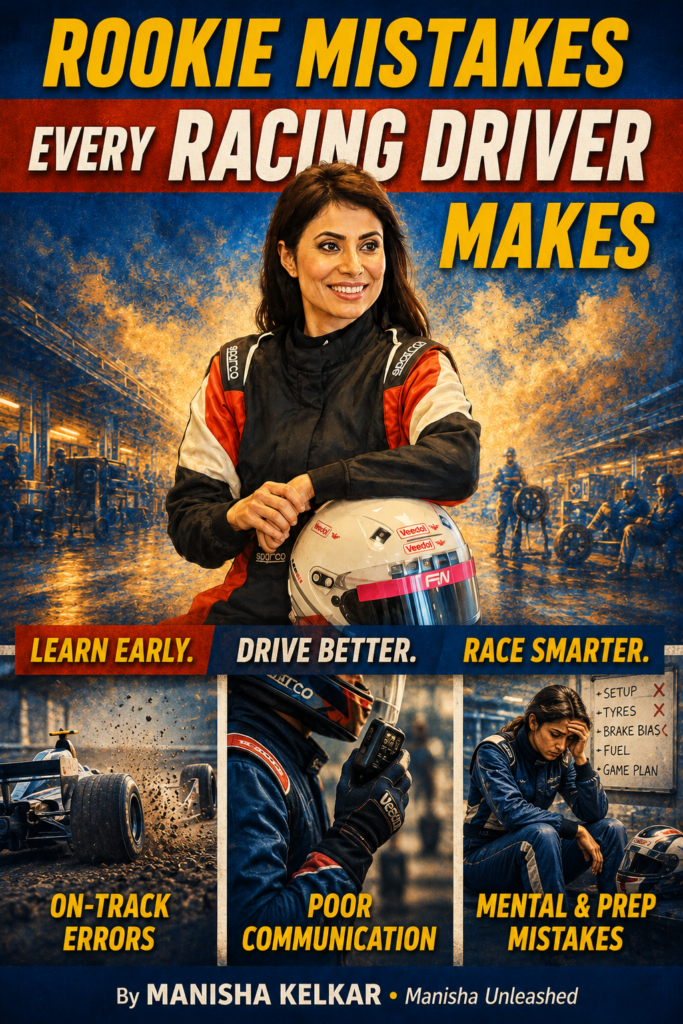
Manisha Unleashed: Rookie Mistakes Every Racing Driver Makes
Every racing driver wants to be fast.
The problem is that when you’re starting out, trying too hard to be fast can actually make you slower.
I know how tempting it is. You climb into a racing car, tighten the belts, pull on your gloves and suddenly feel that every lap has to prove something.
Brake later.
Attack harder.
Carry more speed.
Push more.
Surely that’s how you become a racing driver?
Not necessarily.
One of the biggest lessons motorsport teaches you is that speed is usually the result of doing lots of small things correctly—not simply being brave enough to push harder.
So, for young drivers beginning their motorsport journey, here are some of the rookie mistakes I think almost everyone makes.
And yes, experienced drivers still make some of them too!
1. Braking Too Late
This must be one of the classics.
Every young driver wants to become the last of the late brakers.
You approach a corner and think:
“I can brake ten metres later.”
Then another ten.
Then another five.
Suddenly you’ve arrived at the corner carrying too much speed, missed the apex and destroyed your exit.
Congratulations.
You were incredibly fast into the corner.
Unfortunately, you were incredibly slow coming out of it.
That’s the important lesson.
Late braking doesn’t automatically mean fast braking.
The objective isn’t to brake at the latest physically possible moment. It’s to brake at the point that allows you to slow the car effectively, rotate it and position it correctly for the next phase of the corner.
This becomes especially important when a corner leads onto a long straight.
Sacrificing your exit speed because you wanted to look heroic under braking can cost you all the way down that straight.
My advice: stop asking, “How late can I brake?”
Start asking:
“Where should I brake to produce the fastest complete corner?”
That’s a very different question.
2. Overdriving the Car
This is another mistake almost every ambitious driver discovers.
You’re not happy with your lap time, so naturally you push harder.
You turn the steering wheel more aggressively.
You brake later.
You attack the throttle.
The tyres start sliding.
The car moves around.
Your heart rate goes up.
It feels spectacular.
Then you look at the lap time.
Slower.
Welcome to overdriving.
A racing car has a finite amount of grip. Asking the tyres to do more than they’re capable of doesn’t magically create additional performance.
Often it creates sliding, overheating and lost time.
One of the strangest things about motorsport is that a really fast lap can sometimes feel almost uneventful.
Everything flows.
The braking works.
The car rotates.
You hit the apex.
You unwind the steering.
You apply the throttle.
Nothing dramatic happens.
And then your engineer tells you it was your fastest lap.
My advice: learn to recognise the difference between driving at the limit and driving beyond it.
They’re not the same thing.
3. Trying to Win the Race at the First Corner
The lights go out.
Adrenaline takes over.
Suddenly you see gaps everywhere.
This is particularly dangerous for inexperienced drivers because the opening lap feels like the opportunity to prove yourself.
But races aren’t normally won at Turn 1.
They can certainly be lost there.
Cold tyres, cold brakes, tightly packed cars and drivers taking different lines create a completely different situation from normal racing laps.
You need aggression.
But you also need judgement.
There’s no trophy for gaining four positions in the first corner if you’re watching the rest of the race from the barriers.
My advice: develop controlled aggression.
Attack when the opportunity is genuinely there—not simply because your adrenaline tells you it is.
4. Looking at the Car Directly in Front
Your eyes are one of your most important driving tools.
When you’re inexperienced, it’s easy to become fixated on the car immediately ahead.
They brake.
You brake.
They turn.
You turn.
That’s dangerous because you’re allowing another driver to make decisions for you.
Try to look further ahead.
Watch what’s developing.
Where is the traffic going?
Is somebody about to attempt an overtake?
Is there a yellow flag?
Is the driver two cars ahead slowing unexpectedly?
The earlier you see something, the more time you have to respond.
Your eyes should be ahead of the car.
5. Ignoring Tyres
Young drivers naturally concentrate on steering, braking and throttle.
But tyres are the connection between everything you’re doing and the racetrack.
Learning how tyres behave is one of the biggest steps towards becoming a complete racing driver.
How quickly do they warm up?
How does the balance change as pressures rise?
What happens when they overheat?
How much grip do you have on the opening lap?
How does the car change over a long run?
A driver who understands tyres can manage a race.
A driver who doesn’t may be incredibly quick for a few laps and then wonder where all the grip went.
My advice: start thinking about tyres from the beginning of your career.
They aren’t just black circles attached to the car.
They’re part of your strategy.
6. Ignoring Fitness
This is one I feel strongly about.
Some people still look at racing drivers and think:
“They’re sitting down. How fit do they really need to be?”
Try driving a racing car properly for an extended period and you’ll discover the answer very quickly.
Heat, braking forces, steering effort, vibration, concentration and adrenaline all take energy.
And fatigue affects more than strength.
It affects decision-making.
Your braking becomes less consistent.
Your reactions slow.
Your concentration drops.
Small mistakes begin appearing.
That’s why fitness isn’t something to think about once you reach professional motorsport.
Start early.
Cardiovascular fitness.
Core strength.
Neck strength.
Reaction training.
Hydration.
Nutrition.
Recovery.
These should become normal parts of your preparation.
Don’t wait until you’re exhausted in a race to discover you should have trained harder.
7. Ignoring the Engineer
You’ve just finished a session.
You know exactly what’s wrong.
“The car has terrible understeer.”
Then your engineer opens the data.
Interesting.
Perhaps the problem isn’t entirely the car.
This is where ego can become expensive.
Data doesn’t care how confident you sounded when you climbed out of the cockpit.
If you’re losing time because you’re releasing the brake too early, carrying the wrong speed or applying the throttle too late, the data can reveal it.
A good engineer isn’t there to criticise you.
They’re there to help you become faster.
Learn how to describe what the car is doing.
Listen to questions.
Study telemetry.
Compare laps.
If you have access to a faster teammate’s data, use it.
Your engineer should become one of your most valuable resources.
8. Changing Everything at Once
You’re half a second too slow.
So next lap you brake later, change your line, carry more entry speed and get on the throttle earlier.
Fantastic.
You improve by two-tenths.
Now tell me why.
You can’t.
You changed four things.
Driver development works best when you can understand cause and effect.
Try something.
Observe what happens.
Analyse it.
Then make another change.
That’s how you build knowledge instead of simply accumulating laps.
9. Making Excuses
The tyres were wrong.
Traffic ruined the lap.
The setup wasn’t perfect.
Someone blocked me.
The track changed.
The wind changed.
Sometimes all those things are true.
But constantly searching for reasons why poor performance wasn’t your responsibility prevents you from improving.
One of the most useful questions a racing driver can ask after a disappointing session is:
“What could I have done better?”
There is almost always something.
Taking responsibility doesn’t mean blaming yourself for everything.
It means concentrating on the things you can control.
10. Comparing Yourself With the Wrong People
Motorsport naturally involves comparison.
Lap times make that unavoidable.
But young drivers sometimes become obsessed with beating people who aren’t useful benchmarks.
If you’re serious about improving, compare yourself with the fastest credible reference available.
If your experienced teammate is four-tenths quicker, don’t become depressed.
Become curious.
Where are those four-tenths?
Braking?
Minimum corner speed?
Throttle application?
Racing line?
Technique?
Those four-tenths aren’t an insult.
They’re information.
11. Thinking Talent Is Enough
Natural ability matters.
But motorsport has plenty of talented drivers.
The drivers who progress tend to add something else.
Discipline.
Preparation.
Technical understanding.
Fitness.
Professionalism.
Consistency.
Communication.
Commercial awareness.
Resilience.
You may occasionally beat a better-prepared driver through natural speed.
Over an entire season, preparation becomes much harder to defeat.
12. Forgetting the Business Side of Motorsport
I wish every young driver could progress purely because they’re fast.
Unfortunately, motorsport doesn’t work that way.
Racing is expensive.
That means modern drivers also need to understand sponsorship, media and personal branding.
Learn how to speak professionally.
Learn how to communicate with sponsors.
Understand social media.
Know what value you can provide to a company.
Look after the people supporting you.
And never treat sponsors like walking cash machines.
A successful sponsorship should benefit both sides.
The earlier you understand this, the better prepared you’ll be for the realities of building a racing career.
13. Being Afraid to Make Mistakes
After everything I’ve just written about mistakes, here’s the strange part:
You need to make some.
You will miss braking points.
You will choose the wrong line.
You will overdrive.
You will make poor setup decisions.
You will lose races you could have won.
You may even have weekends where absolutely nothing seems to work.
That’s motorsport.
The objective isn’t to become a driver who never makes mistakes.
It’s to become a driver who doesn’t keep making the same ones.
Every mistake should teach you something.
My Advice to Young Drivers
If you’re beginning your racing career, don’t obsess about looking fast.
Concentrate on becoming fast.
There is a difference.
Learn your craft.
Listen.
Ask questions.
Study data.
Train your body.
Understand the car.
Race strong competitors.
Look after your tyres.
Build relationships with engineers.
Learn the commercial side.
And when something goes wrong, analyse it instead of hiding from it.
Most importantly, be patient.
A racing career isn’t built from one spectacular qualifying lap.
It’s built from thousands of laps, hundreds of small lessons and the determination to keep improving.
The driver you are today doesn’t have to be the driver you are next year.
That’s one of the things I love about motorsport.
There is always something else to learn.
And usually, the stopwatch is very happy to tell you exactly how much learning you still have to do!
— Manisha Kelkar
Manisha Unleashed | Motorsport Mania
Learn. Improve. Race. Repeat. 🏁