
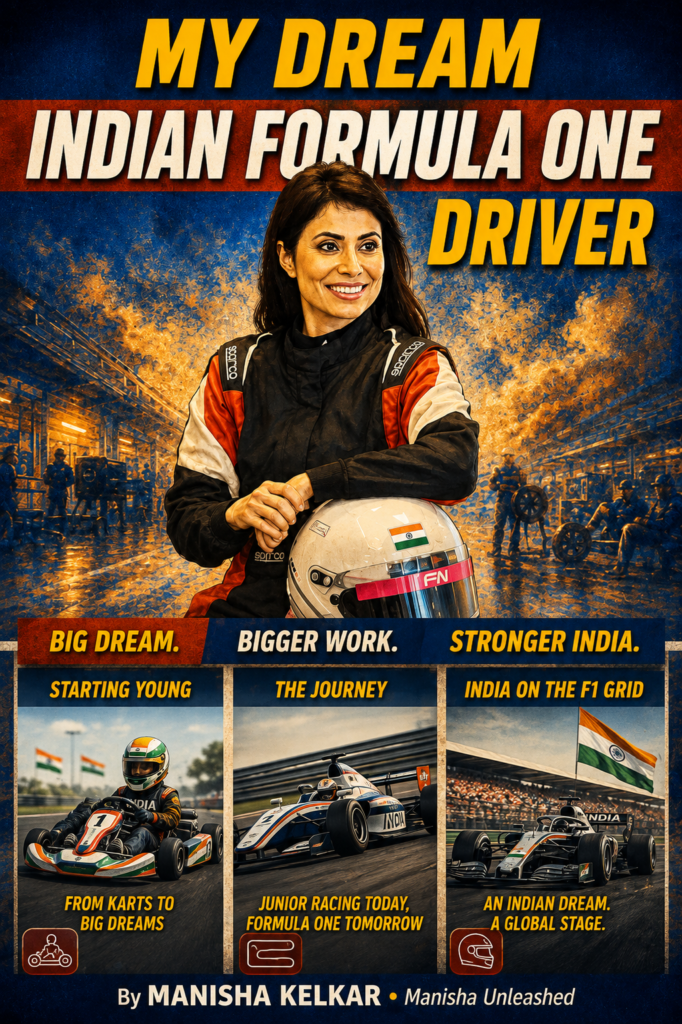
Manisha Unleashed: My Dream Indian Formula One Driver
India has produced Formula One drivers before. What I want to see next is something even bigger.
I want to see an Indian Formula One World Champion.
Not simply an Indian driver who reaches Formula One. Not someone who gets a few races, attracts attention and disappears again.
I want to see an Indian driver standing on the top step of the podium, winning Grands Prix and ultimately fighting for the Formula One World Championship.
Can it happen?
Absolutely.
But I don’t believe talent alone will get us there.
India Doesn’t Have a Talent Problem
India has a population of more than a billion people. Somewhere among those millions of children fascinated by cars and racing, I believe there are drivers with the natural ability to compete at the highest level.
The problem is finding them early enough and then giving them the environment in which that talent can develop.
India already has organised karting and national racing championships, while the Federation of Motor Sports Clubs of India has been working with the FIA on an India Development Program that specifically identifies making grassroots motorsport more accessible and affordable as one of its priorities. (FMSCI)
That’s encouraging.
But producing a Formula One World Champion requires something much bigger.
We Need to Start Younger
Look at the development of many successful international racing drivers and one thing becomes obvious.
They started very young.
By the time many Indian youngsters seriously consider motorsport, drivers in established racing countries may already have years of karting experience.
Those early years aren’t simply about learning how to drive quickly.
They teach racecraft.
How do you defend?
How do you overtake?
How do you race wheel-to-wheel?
How do you perform under pressure?
How do you adapt when conditions change?
How do you lose a race, understand why you lost it and come back stronger?
Those lessons need thousands of racing kilometres.
India therefore needs far more opportunities for children to experience competitive karting at an affordable level.
And we need to identify exceptional talent before financial circumstances decide who continues and who disappears.
The importance of grassroots participation isn’t unique to India. Three-time W Series champion Jamie Chadwick recently argued that creating opportunities at grassroots level, including getting children interested from a very young age, is fundamental to developing future elite drivers. (Reuters)
The Infrastructure Problem
This is where India faces one of its biggest challenges.
Countries such as Britain and Italy have motorsport ecosystems that have developed over generations.
There are circuits, kart tracks, racing schools, teams, engineers, mechanics, manufacturers, suppliers, coaches and championships operating at multiple levels.
A young driver can become part of that environment.
India has motorsport infrastructure and a passionate racing community, but we don’t yet have that same depth of ecosystem.
And a Formula One driver isn’t created by a circuit alone.
Imagine an Indian motorsport development centre containing:
Karting → Driver Academy → Simulator Centre → Fitness Centre → Engineering Academy → Junior Formula Team → Sports Car Programme
Now surround that with professional coaches, engineers, sports psychologists, nutritionists, data engineers and commercial-development specialists.
That begins to look like a pathway, rather than a collection of unrelated racing opportunities.
There are encouraging signs. Indian motorsport authorities have discussed initiatives including a motorsport Centre of Excellence, while the existing FIA-supported development programme has also focused on grassroots participation and engineering development. (The Times of India)
But those ideas need to become part of a sustained long-term strategy.
Money Cannot Continue to Decide Everything
This may be the hardest problem.
Motorsport is expensive.
Very expensive.
A talented footballer needs boots and somewhere to play. A young racing driver needs equipment, testing, tyres, mechanics, transport and increasingly expensive cars as they progress.
Eventually they may need enormous budgets to compete internationally.
That means India could discover an extraordinary young driver tomorrow and still lose them because their family cannot finance the next stage.
If we genuinely want an Indian Formula One champion, talent identification must eventually be connected to funding.
Imagine a national programme where thousands of youngsters compete in affordable karting events.
The strongest progress to regional championships.
The best progress to national competition.
A handful receive funded international karting opportunities.
And the exceptional drivers enter a structured programme taking them into Formula 4 and beyond.
Suddenly we’re not waiting for one wealthy family to produce India’s next Formula One driver.
We’re searching for them.
Indian Companies Need to Think Differently About Sponsorship
This is another area where change could make an enormous difference.
Don’t wait until the driver reaches Formula 2 before deciding they’re worth supporting.
By then, the development process has almost finished.
Support them at 12, 14, 16 and 18.
Imagine several major Indian companies jointly funding a driver academy.
One driver might fail.
Another might reach Formula 3.
Another could become a professional endurance racer.
And perhaps, once in a generation, one reaches Formula One.
That isn’t wasted investment.
It’s how you build a motorsport culture.
Young Indian Drivers Must Also Think Differently
The responsibility isn’t entirely with federations, circuits or sponsors.
Young drivers themselves need to understand that modern motorsport requires much more than being fast.
If you want Formula One, you need to behave like a professional driver before you become one.
Learn fitness.
Learn nutrition.
Understand vehicle dynamics.
Study data.
Learn how tyres work.
Learn how to communicate with engineers.
Use simulators intelligently.
Study onboard footage.
Understand sponsorship.
Build your media skills.
Learn how to represent companies professionally.
And perhaps most importantly:
Race against the strongest competition you can find.
Winning repeatedly in a comfortable environment may look impressive.
Being beaten by faster drivers can sometimes teach you far more.
Go International Earlier
At some point, a serious Indian Formula One prospect will probably need to compete internationally.
That’s simply where much of the established junior single-seater ladder currently exists.
But I would change the mentality.
Don’t arrive thinking:
“I am India’s best young driver.”
Arrive thinking:
“I am here to discover how good I really am.”
Then learn.
If you’re three-tenths slower, understand why.
If your teammate is faster through one corner, study the data.
If you’re struggling in qualifying, find the weakness.
Don’t protect your reputation.
Improve your performance.
That’s the mentality I believe India’s future champion will need.
My Dream Indian Formula One Driver
So who is my dream Indian Formula One driver?
I don’t know their name.
I don’t know whether they’re a boy or a girl.
They might be six years old today, driving a kart somewhere in India.
Perhaps they haven’t even discovered motorsport yet.
But I know what I want them to become.
Fast, obviously.
But also technically intelligent.
Physically prepared.
Commercially aware.
Mentally resilient.
Comfortable competing internationally.
And completely uninterested in being described as good for an Indian driver.
I want them compared with the best drivers in the world.
Because ultimately that is the standard that matters.
India Shouldn’t Aim to Produce Another F1 Driver
We should aim higher.
Build grassroots karting.
Make participation more affordable.
Develop coaches and engineers.
Create academies.
Connect national racing to international competition.
Bring companies into the journey earlier.
Identify talent using performance rather than wealth.
And give exceptional young drivers enough time, racing and support to discover how good they can become.
Do all of that consistently for ten or twenty years and India’s chances change dramatically.
My dream isn’t simply to hear the Indian national anthem associated with Formula One.
It’s to hear it because an Indian driver has just won.
And one day, I want the motorsport world to say:
FORMULA ONE WORLD CHAMPION — INDIA. 🇮🇳
That is the dream.
— Manisha Kelkar
Manisha Unleashed | Motorsport Mania