Manisha Unleashed
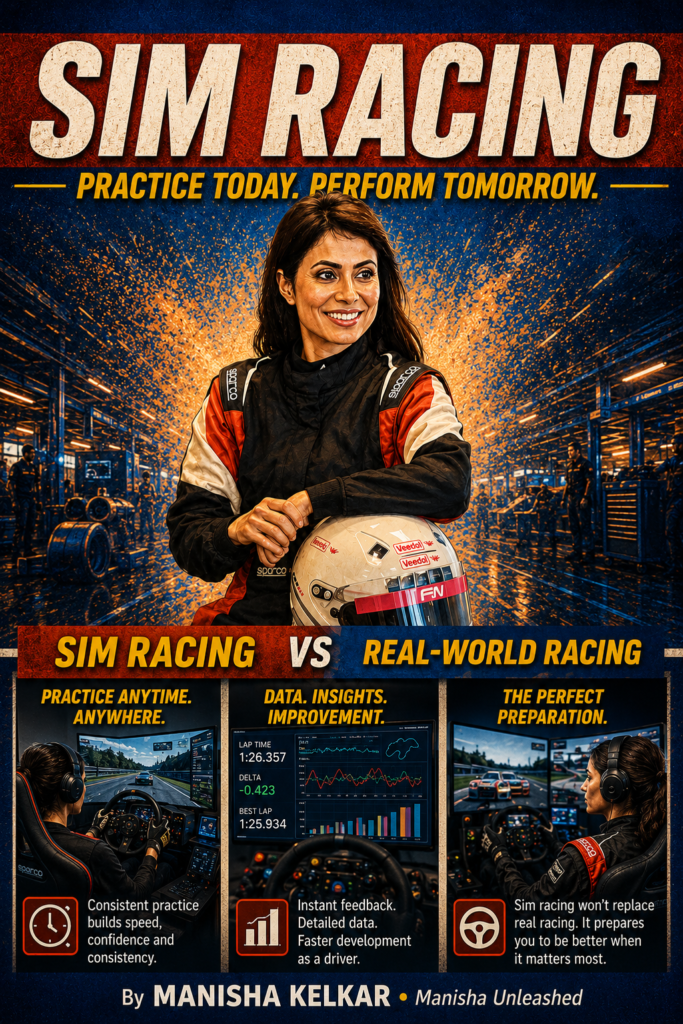
Is Sim Racing Creating the Next Generation of Real Racing Drivers?
Could a teenager with a simulator realistically compete with someone who grew up racing karts?
For generations, there has been a fairly predictable answer to the question:
“How do I become a racing driver?”
Start karting.
Start young.
Race as often as possible.
Progress through increasingly powerful machinery.
Find sponsors.
Keep winning.
And perhaps, if you’re exceptionally talented, extremely determined and have access to enough money, you’ll eventually build a professional racing career.
But something has changed.
Today, a teenager can sit in a bedroom with a steering wheel, pedals and simulator and race thousands of laps around Silverstone, Spa, Monza or Le Mans without ever leaving home.
They can race against people from around the world.
They can analyse telemetry.
Experiment with setup.
Practise qualifying.
Learn racecraft.
Drive in the rain.
And repeat the same corner hundreds of times if they want.
So here’s this week’s Unleashed Truth:
Could the next great racing driver begin their career on a simulator rather than in a kart?
And could a teenager who has spent years sim racing realistically compete against someone who has been racing karts since they were six?
I think the answer is becoming much more interesting.
First, Sim Racing Is Not a Video Game
This is probably the biggest misconception.
There is an enormous difference between casually playing a racing game and serious simulator racing.
A competitive sim racer isn’t simply pressing buttons.
They’re learning many of the same principles that matter in a real racing car.
Braking points.
Racing lines.
Throttle control.
Weight transfer.
Oversteer.
Understeer.
Tyre management.
Race starts.
Overtaking.
Defending.
Strategy.
Consistency.
And increasingly, data analysis.
A serious simulator with good pedals, steering feedback and accurate software can create a surprisingly sophisticated learning environment.
No, it isn’t identical to driving a real racing car.
But dismissing it as “just gaming” misses what modern simulation can teach.
The Biggest Advantage: Seat Time
This is where sim racing becomes incredibly powerful.
Imagine two 14-year-old drivers.
One races karts.
Their family can afford perhaps 15 race weekends and some testing each year.
The other owns a simulator.
They can drive:
Monday. Tuesday. Wednesday. Thursday. Friday.
And then race online all weekend.
They can potentially accumulate hundreds of hours of competitive driving every year.
That matters.
Because becoming good at almost anything requires repetition.
A karting driver might get more realistic experience per lap.
But the sim racer can potentially complete far more laps.
And they can make mistakes cheaply.
Spin?
Reset.
Crash?
Reset.
Miss the braking point?
Try again.
In real motorsport, every mistake can cost money.
Sometimes a lot of money.
In simulation, mistakes primarily cost time.
That creates an extraordinary learning environment.
Sim Racing Democratises Motorsport
This is perhaps the part that excites me most.
Motorsport has always had a huge problem.
Money determines who gets to participate.
Karting can become extremely expensive.
Then come Formula cars.
Testing.
Tyres.
Engineers.
Travel.
Hotels.
Mechanics.
Entry fees.
Accident damage.
The financial barriers grow at almost every stage.
A simulator isn’t free.
A sophisticated setup can still cost serious money.
But compared with several seasons of competitive international karting?
The difference is enormous.
Suddenly someone from an ordinary family can practise racing.
Someone in India can race someone in Britain.
Someone in Brazil can compete against someone in Japan.
And talent can begin appearing in places traditional motorsport might never have looked.
That’s potentially revolutionary.
Imagine the Driver We Might Never Have Discovered
I’ve written before about how motorsport’s financial structure can eliminate talented drivers before they have the opportunity to demonstrate their ability.
Sim racing changes that equation.
Imagine a teenager living somewhere with no nearby kart circuit.
Their family couldn’t possibly finance a conventional racing career.
But they have extraordinary natural ability.
On a simulator, they begin winning.
First locally.
Then nationally.
Then internationally.
Suddenly their performance is visible.
Without simulation, motorsport might never have known they existed.
That doesn’t mean they’re automatically ready for a racing car.
But now we have identified someone worth testing.
That’s the important difference.
But Can Simulator Speed Transfer to a Real Car?
This is the big question.
And the answer is:
Some of it can.
A good sim racer may already understand racing lines.
They may understand braking technique.
They may recognise understeer and oversteer.
They may know how to analyse telemetry.
They may understand setup changes.
They may have excellent visual processing and reactions.
They may also have thousands of hours of racecraft.
Put them into a real racing car and they aren’t necessarily starting from zero.
But they’re also going to discover several things their simulator never properly taught them.
The Simulator Doesn’t Scare You
This is probably the biggest difference.
You can drive through Eau Rouge flat-out on a simulator.
Crash.
Press reset.
Try again.
In a real racing car, your brain knows something very different is happening.
Speed feels real.
The barriers look real.
The consequences are real.
You feel acceleration.
Braking.
Cornering forces.
Vibration.
Heat.
Noise.
And perhaps most importantly:
fear.
Managing fear is part of being a racing driver.
I’m not talking about being terrified.
I’m talking about that instinctive voice in your head that understands there are consequences if you get something wrong.
Learning to operate near the limit while respecting those consequences is something a simulator struggles to reproduce.
You Cannot Simulate G-Forces Properly
This is another major difference.
A screen can show you that the car is cornering.
Force feedback can tell your hands something about what the front tyres are doing.
But your body isn’t experiencing the same forces.
In a real racing car, information arrives through everything.
Your hands.
Your feet.
Your back.
Your neck.
Your inner ear.
The seat.
You feel the car moving beneath you.
That physical feedback becomes part of how you understand grip.
Real drivers develop an extraordinary sensitivity to those sensations.
A sim racer has to learn them when transitioning to reality.
And Then There’s Fitness
You can be an extraordinary sim racer without possessing the physical conditioning required for a racing car.
Real racing demands fitness.
Heat.
Braking forces.
Steering effort.
Vibration.
Neck loading.
Concentration.
Dehydration.
Fatigue.
A driver might know exactly what they need to do technically but discover that after 30 minutes their body can no longer execute it consistently.
That’s why any serious sim-to-real programme needs physical preparation.
Cardiovascular training.
Core strength.
Neck training.
Reaction work.
Nutrition.
Hydration.
Fitness doesn’t make you talented.
But poor fitness can prevent you from using your talent.
What Does Karting Teach That Simulation Doesn’t?
This is why I don’t think karting is about to disappear.
Karting teaches something extremely valuable:
physical instinct.
A child who has raced karts since six has spent years feeling grip.
They know what cold tyres feel like.
They know what happens when rubber builds up on a circuit.
They understand contact.
They understand changing weather.
They’ve experienced mechanical problems.
They’ve raced when the kart isn’t perfect.
They’ve had someone actually alongside them entering a corner.
They’ve crashed.
They’ve been hurt.
They’ve made mistakes they couldn’t undo by pressing reset.
Those experiences develop judgement.
And judgement is difficult to simulate.
So Who Would Be Faster?
Let’s create an experiment.
Two 16-year-olds.
Driver A
Started karting at six.
Ten years of real competition.
Strong racecraft.
Excellent physical feel.
Limited simulator experience.
Driver B
Started sim racing at eight.
Eight years of simulation.
Thousands of hours of practice.
Exceptional online results.
Strong telemetry knowledge.
Almost no real-world racing experience.
Put them immediately into a Formula 4 car.
Who wins?
I’d probably put my money on Driver A initially.
The karting driver understands the physical environment.
But that’s not the interesting question.
The interesting question is:
What happens after Driver B gets ten days of proper testing?
Now I’m much less certain.
If the simulator driver has genuine talent and adapts quickly to physical feedback, the gap could disappear surprisingly fast.
And if it does, motorsport has discovered something extremely important.
The Future Driver Might Be Hybrid
Perhaps we’re asking the wrong question.
Maybe it shouldn’t be:
Karting OR simulation?
Maybe the ideal development programme uses both.
Imagine a young driver racing karts twice a month while spending several evenings each week on a simulator.
Karting provides:
Physical feedback.
Real-world risk.
Mechanical understanding.
Racecraft.
Changing conditions.
The simulator provides:
Huge amounts of repetition.
Circuit learning.
Data analysis.
Setup experimentation.
Mental training.
Low-cost practice.
Put those together and you potentially create a much more complete development environment.
Simulators Can Also Make Real Testing More Valuable
This is particularly important as drivers progress.
Real testing is expensive.
Very expensive.
If you have only one day in a race car, you don’t want to spend the first two hours learning whether the next corner goes left or right.
Learn the circuit beforehand.
Practise the braking zones.
Understand the sequences.
Study different lines.
Develop a mental map.
Then when you arrive at the real circuit, your limited track time can be spent learning the things the simulator cannot teach you.
Real grip.
Real braking.
Real tyres.
Real forces.
That makes every expensive kilometre more productive.
Could Sim Racing Find Talent in India?
This is where I think the opportunity becomes particularly exciting.
India has an enormous young population.
But motorsport remains financially inaccessible to many families.
Building enough kart circuits and funding enough racing programmes to search the entire country for talent would be extremely difficult.
Simulation could dramatically widen that search.
Imagine regional sim racing centres.
Schools competing.
National championships.
Standardised equipment.
Thousands of teenagers participating.
Then take the fastest 100.
Put them through more sophisticated simulator assessments.
Take the fastest 20.
Put them into karts.
Take the fastest five.
Give them proper driver development programmes.
Suddenly we’re using technology to search for talent on a scale traditional motorsport could never afford.
Would every brilliant sim racer become a brilliant real driver?
Absolutely not.
But you don’t need everyone to succeed.
You need the system to find the exceptional few.
Engineers Will Benefit Too
There’s another side of simulation that doesn’t receive enough attention.
Not everyone involved in sim racing needs to become a driver.
Simulation can introduce young people to:
Vehicle dynamics.
Race engineering.
Telemetry.
Strategy.
Setup development.
Data analysis.
Software.
Aerodynamics.
That means sim racing could help create not only the next generation of drivers but also the next generation of motorsport engineers.
And motorsport needs both.
The Danger: Learning Unrealistic Habits
Simulation isn’t perfect.
Software has limitations.
Tyre models aren’t reality.
Physics models make assumptions.
Hardware varies enormously.
And drivers can develop techniques that work brilliantly in a particular simulation but don’t translate perfectly to a real car.
That’s why simulator training needs perspective.
A simulator is a tool.
Not reality.
The objective shouldn’t be to become brilliant at exploiting a piece of software.
It should be to develop skills that transfer.
That’s a subtle but important difference.
Would I Put a Sim Racer Straight Into a Race Car?
No.
I’d test them first.
And I think that’s exactly where the opportunity lies.
If someone demonstrates exceptional simulator performance, give them a structured real-world assessment.
Start with karting.
Then perhaps a race school.
Evaluate their adaptability.
How quickly do they understand physical grip?
How do they react to speed?
Can they communicate with an engineer?
Are they consistent?
Can they translate what they learned virtually into reality?
If the answer is yes, keep going.
Talent identification should be about opening doors.
Simulation could become one of those doors.
The Uncomfortable Truth
Here’s my Unleashed Truth.
The next extraordinary racing driver might already exist — but motorsport may never find them because they cannot afford to race.
Simulation gives us an opportunity to change that.
A teenager shouldn’t necessarily need wealthy parents, an international karting programme and ten years of racing expenditure before somebody asks:
“Are they actually fast?”
Perhaps a steering wheel, pedals and computer can provide the first answer.
Not the final answer.
The first answer.
Then real-world motorsport can determine the rest.
So, Could a Sim Racer Beat Someone Who Grew Up Karting?
Immediately?
Probably not.
Eventually?
Absolutely possible.
The crucial factor would be adaptability.
If a brilliant simulator driver can quickly learn physical feedback, manage fear, develop fitness and translate virtual techniques into real-world performance, they may be able to close years of traditional experience surprisingly quickly.
And that possibility should make motorsport pay attention.
Because for more than a century, racing has searched for drivers primarily among people who could afford to race.
Simulation allows us to search somewhere much bigger.
Among people who might simply be fast.
What Would I Change?
I’d like to see manufacturers, racing teams and national motorsport organisations create serious Sim-to-Race talent programmes.
Not marketing competitions where the winner gets a few demonstration laps.
Real development pathways.
Online competition → National final → Professional simulator assessment → Kart test → Race-car assessment → Funded development programme.
Make the first stage accessible.
Make the equipment as equal as possible.
Judge performance objectively.
Then give exceptional drivers the opportunity to prove whether their ability transfers into reality.
Some will fail.
That’s fine.
Talent programmes are supposed to eliminate candidates.
But occasionally we might discover someone extraordinary.
Someone motorsport would otherwise never have known existed.
Now It’s Your Turn
So here’s this week’s Unleashed Truth question:
Is sim racing creating the next generation of real racing drivers?
Could a teenager who has spent thousands of hours racing virtually eventually beat someone who has been karting since childhood?
Or are the physical sensations, risk and real-world experience of karting impossible to replace?
And here’s the question I’d really like to test:
If you were running a professional racing team and had one funded junior seat available, would you rather test the national karting champion — or the world’s fastest teenage sim racer?
I’d test both.
Because the stopwatch doesn’t care where you learned to drive.
It only cares how fast you are.
— Manisha Kelkar
Manisha Unleashed | Motorsport Mania
UNLEASHED TRUTH
Asking the questions motorsport doesn’t always want to answer.