Manisha Unleashed
Should Drivers Be Allowed to Race Without Team Orders?
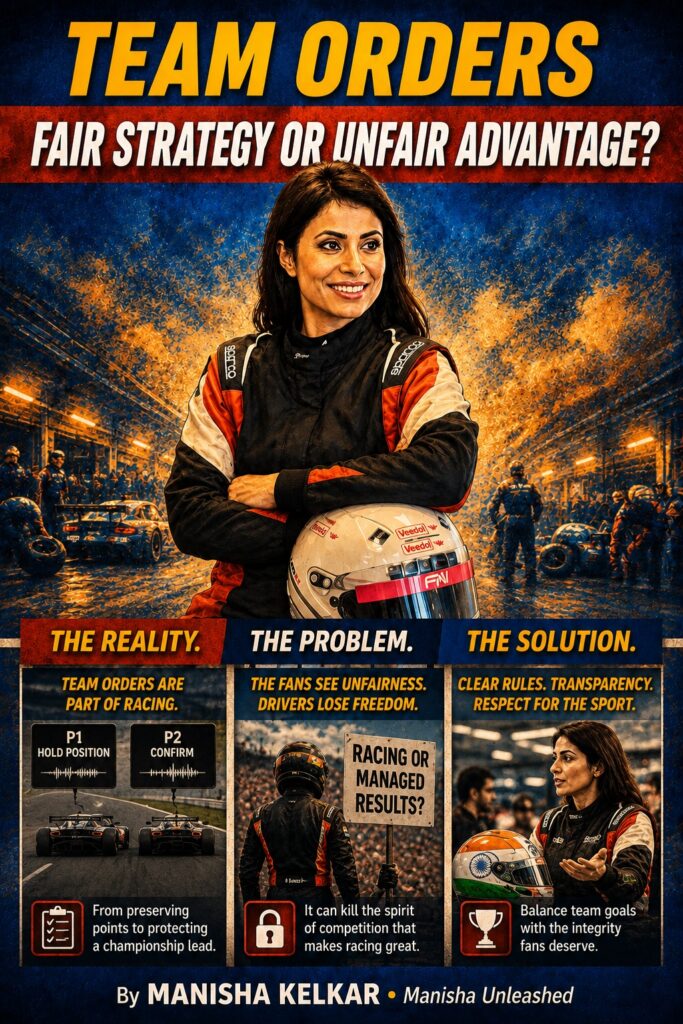
When should a team be entitled to tell one driver to move aside?
There are few radio messages guaranteed to annoy racing fans more than:
“Let your teammate through.”
Immediately, the arguments begin.
“Let them race!”
“This isn’t racing anymore!”
“If the other driver is faster, they should overtake!”
I understand that reaction.
As a racing driver, the last thing I would want to hear while fighting for position is an engineer telling me to move aside.
We’re racers.
We’re supposed to compete.
But motorsport has an uncomfortable complication.
The person you’re trying desperately to beat may be driving a car owned by the same team.
And that team may have millions invested in winning a championship.
So here’s this week’s Unleashed Truth:
Should racing drivers always be allowed to race their teammates—or are there situations where the team has every right to intervene?
My answer?
Sometimes drivers should race.
Sometimes the team should decide.
The difficult part is knowing when.
Why Do We Hate Team Orders?
Because racing is supposed to answer a simple question:
Who is fastest?
Two drivers arrive at a corner.
One attacks.
The other defends.
Who comes out ahead?
That’s racing.
Now imagine the same situation and suddenly a voice comes over the radio:
“Position swap. Car behind is faster.”
The battle disappears.
No overtaking move.
No defence.
No risk.
No drama.
The result has effectively been decided from the pit wall.
As a fan, I understand why that feels artificial.
And as a driver, I understand why it can feel even worse.
Nobody wants to be told:
“You’re not allowed to fight.”
But Motorsport Isn’t Tennis
Here’s the problem.
Motorsport is unusual because it is simultaneously an individual sport and a team sport.
The driver wants to win.
But the team also wants to win.
Those objectives are normally aligned.
Until they aren’t.
Imagine two teammates fighting aggressively for the lead.
They touch.
Both cars retire.
Suddenly the team’s engineers, mechanics and everyone else who spent days preparing those cars watch their work disappear because two drivers refused to give each other an extra metre.
The drivers might say:
“We were racing.”
The team principal might say:
“You just cost us 40 championship points.”
Both arguments have some validity.
Your Teammate Is Your Greatest Rival
This is one of the fascinating things about motorsport.
Your teammate should be the person helping the team achieve success.
But they’re also often your most important benchmark.
Same car.
Same engine.
Same tyres.
Same engineers.
Same circuit.
If your teammate is faster, there are fewer places to hide.
And if you’re trying to build your reputation, beating your teammate matters enormously.
That’s why asking one driver to move aside isn’t a small request.
You’re not simply giving away a position.
You may be giving points to the person you’re measured against.
Perhaps even the person you’re fighting for the championship.
That’s why team orders can become so controversial.
Scenario One: Race One of the Season
Let’s make this simple.
First race.
Both drivers have zero points.
They’re running first and second.
Similar pace.
No mechanical problems.
Plenty of racing remaining.
Should the team decide who wins?
Absolutely not.
Let them race.
If you begin manipulating positions before the championship has even developed, you’re no longer allowing competition to determine which driver has the stronger season.
Give both drivers equal opportunity.
There should be one condition:
Don’t hit each other.
Race hard.
Race fairly.
Leave enough room.
Bring both cars home.
That should be the starting philosophy.
Scenario Two: One Driver Is Clearly Faster
Now things become more complicated.
Driver A is leading.
Driver B catches them quickly.
Driver B is obviously faster.
There is another competitor five seconds ahead.
Should Driver A be told to move aside?
Possibly.
But I would first give Driver B the opportunity to overtake.
If you’re genuinely faster, prove it.
That’s racing.
However, if Driver A spends five laps aggressively defending while both cars lose time to a rival, the team may reasonably intervene.
At that point, the fight between teammates is damaging the team’s overall result.
I’d prefer a message such as:
“Don’t hold your teammate up unnecessarily.”
That’s different from manufacturing a result.
It allows the faster driver to demonstrate their pace.
Scenario Three: The Championship Is at Stake
Now imagine the final few races.
Driver A is fighting for the World Championship.
Driver B mathematically cannot win it.
They are running second and third.
Those additional points could decide the title.
Should Driver B move aside?
For me:
Yes.
I know some fans will disagree.
But motorsport isn’t simply about individual races.
Championships matter.
If one driver can win the championship and the other cannot, I think the team has every right to maximise its chances.
At that point, the drivers aren’t in equivalent sporting situations.
One is fighting for something the other can no longer achieve.
I’d move over.
Would I enjoy doing it?
Absolutely not.
But I’d understand why.
Scenario Four: Both Drivers Can Win the Championship
This is where my opinion changes completely.
Two races remaining.
Both drivers can realistically win the championship.
They’re first and second.
Should the team decide which one gets priority?
No.
Let them race.
If both drivers have earned the right to fight for the championship, the team shouldn’t artificially select a winner.
There should still be rules.
No deliberate contact.
No reckless moves.
Respect each other.
But let performance decide.
Otherwise, why have two drivers?
“If You’re Faster, Overtake Me”
Drivers often say this.
And I sympathise.
If my teammate is supposedly faster, why should I simply surrender?
Come and pass me.
But there’s another perspective.
Imagine your teammate is on fresh tyres and you’re on tyres that are 20 laps old.
You’re not fighting the same strategic race.
Defending aggressively might cost both cars several seconds.
Should your teammate risk contact simply to demonstrate they can overtake you?
Probably not.
This is where strategy makes team orders more complicated.
Sometimes moving aside isn’t admitting:
“You’re the better driver.”
It’s simply recognising:
“We’re running different races.”
That’s an important distinction.
What About Different Strategies?
This is one area where I have very little problem with temporary position swaps.
Imagine Driver A is attempting a one-stop strategy.
Driver B has recently stopped and is on much fresher tyres.
Driver B catches Driver A.
Why destroy both strategies by forcing them to fight?
Let Driver B through.
But—and this matters—if the strategic situation later reverses, the team should be prepared to return the position where appropriate.
That makes it tactical rather than political.
Drivers are much more likely to cooperate when they trust the team to behave fairly.
The Biggest Problem Is Favouritism
This is where team orders become dangerous.
If drivers believe the team has already chosen its favourite, trust disappears.
One driver receives priority strategy.
One receives upgrades first.
One gets favourable pit stops.
Then they’re asked to move aside.
At that point, the championship can become self-fulfilling.
The favoured driver scores more points because they’re receiving better opportunities.
The team then says:
“They’re ahead in the championship, so they deserve priority.”
But why are they ahead?
Perhaps partly because they were given priority.
That’s why teams need transparency.
Both drivers should understand the rules before the race starts.
Establish the Rules Before the Helmets Go On
This is what I would do as a team principal.
Before the season begins, both drivers sit down together.
The rules are clear.
Early season:
Race each other freely.
Different strategies:
Cooperate where necessary.
Faster car approaching:
Don’t unnecessarily damage the team’s race.
Championship situation:
Priority may be given once one driver has a clearly superior realistic championship opportunity.
Final races with both drivers still in contention:
Race.
One absolute rule:
Do not take your teammate out.
Everyone understands.
No surprises.
No mysterious radio messages.
No rules invented halfway through the Grand Prix.
That doesn’t eliminate disagreement.
They’re racing drivers.
There will always be disagreement.
But at least everyone knows the framework.
The “Don’t Crash” Rule Sounds Easier Than It Is
People often say:
“Just let them race but tell them not to crash.”
Wonderful.
Unfortunately, racing doesn’t work like that.
Nobody deliberately plans:
“I’ll make a perfectly reasonable overtaking attempt and accidentally remove both cars.”
Incidents happen because drivers operate incredibly close to the limit.
One brakes slightly later.
The other closes the door.
One expects space.
The other expects them to back out.
Contact.
That’s why racing teammates requires judgement.
Sometimes the smartest move isn’t the bravest one.
If you’re racing another team’s car, you might take a 60/40 opportunity.
Against your teammate?
Perhaps you wait for something better.
That’s part of being a professional.
What Does the Driver Owe the Team?
This question is rarely discussed.
Drivers understandably talk about their own championships.
But who put the car underneath them?
Mechanics may have worked through the night.
Engineers spent months developing it.
Sponsors financed the programme.
Hundreds of people may depend on the team’s success.
The driver isn’t operating independently.
That means there are moments when personal ambition has to recognise the interests of the organisation.
If I’m mathematically eliminated from a championship and my teammate can win it, I’m part of that team.
Helping them win becomes part of my job.
I might hate giving up the position.
But professional sport isn’t always about doing what you personally enjoy.
But What Does the Team Owe the Driver?
Fairness.
This works both ways.
If a team signs two drivers and tells them they have equal status, it should honour that promise until there is a legitimate sporting reason to change it.
Don’t sabotage one driver’s strategy to help the other.
Don’t manipulate early races unnecessarily.
Don’t tell one driver they’re free to race and then change the rules because the result isn’t convenient.
Trust is incredibly important between a driver and their team.
Once that trust disappears, every strategic decision becomes suspicious.
And that can destroy a team from inside.
Endurance Racing Changes Everything
This subject becomes very different in endurance racing.
At Le Mans, several drivers share one car.
Suddenly the mentality changes.
My teammate isn’t driving the car beside me.
They’re going to climb into my car later.
Their success is my success.
Their mistake is my problem.
My mistake is their problem.
That’s one of the things I find fascinating about endurance racing.
Individual ego has to become secondary.
The question isn’t:
“How do I beat my teammate?”
It’s:
“How do we beat everyone else?”
For someone pursuing the Road to Le Mans, that’s a mentality I think is incredibly important.
Would Motorsport Be Better Without Team Orders?
In some ways?
Yes.
Imagine every race with one simple rule:
Drivers race. Teams cannot interfere.
It sounds fantastic.
But then reality arrives.
Different tyre strategies.
Fuel saving.
Championship mathematics.
Mechanical problems.
Constructor points.
Safety concerns.
Suddenly an absolute ban becomes difficult to justify.
And history has shown us something else.
Teams will find ways to communicate what they want.
A suspicious pit stop.
A strategic decision.
A coded radio message.
An unexplained loss of pace.
I’d rather team orders were visible and open to scrutiny than disguised as something else.
My Rule: Team Orders Must Have a Sporting Reason
This is where I draw the line.
A team order should solve a legitimate sporting problem.
Protect a championship opportunity.
Manage different strategies.
Avoid unnecessary loss of time.
Protect a mechanical issue.
Maximise the team’s result.
What I don’t like is using team orders simply because:
“We prefer this driver.”
That’s not strategy.
That’s manipulation.
What If I Were Told to Move Aside?
Would I do it?
It depends.
Race two of the championship with equal points?
I’d want a very good explanation.
Different strategies and my teammate is significantly faster?
Yes.
I’m out of championship contention and my teammate needs the points to win the title?
Yes.
Final race, both of us can become champion?
No. Let us race.
And if I’m told my teammate is faster?
Well…
Perhaps they should come and demonstrate it.
I’m still a racing driver after all.
The Uncomfortable Truth
Here’s my Unleashed Truth:
Team orders aren’t inherently anti-racing. Unfair team orders are.
Motorsport is a team sport pretending to be an individual sport.
That’s what makes this issue impossible to eliminate.
Drivers need freedom to compete.
Teams need the ability to manage championships.
Both can be true.
The important things are timing, fairness and transparency.
A team shouldn’t decide a championship before the drivers have had the opportunity to decide it themselves.
But once only one driver can realistically deliver the title, pretending the team has no interest in helping them is unrealistic.
What Would I Change?
I’d introduce one principle across every team I ran:
Race until there is a genuine sporting reason not to.
Don’t manufacture hierarchy unnecessarily.
Don’t decide in March who should be champion in November.
Let results create the hierarchy naturally.
If one driver consistently becomes the stronger championship contender, then priorities can change.
Until then?
Race.
And make the rules clear from the beginning.
So, Should Drivers Be Allowed to Race Without Team Orders?
Whenever reasonably possible:
Yes.
Fans deserve genuine competition.
Drivers deserve the opportunity to prove themselves.
But racing doesn’t exist separately from strategy.
There are circumstances where a team has every right to intervene.
The crucial question shouldn’t be:
“Were team orders used?”
It should be:
“Was there a legitimate sporting reason for using them?”
If there was, I can accept it.
If there wasn’t?
Let them race.
Now It’s Your Turn
Here’s this week’s Unleashed Truth question:
Your driver is leading the race, but cannot win the championship.
Their teammate is directly behind and needs the victory to become World Champion.
Do you order the leader to move aside?
I would.
Now make it harder.
Both drivers can win the championship.
Do you still issue the order?
For me, absolutely not.
Take away the radio message. Give them the track. And may the fastest driver win.
Because sometimes the most important job of a racing team is knowing when to manage the race.
And sometimes it’s knowing when to stay out of it.
— Manisha Kelkar
Manisha Unleashed | Motorsport Mania
UNLEASHED TRUTH
Asking the questions motorsport doesn’t always want to answer.