
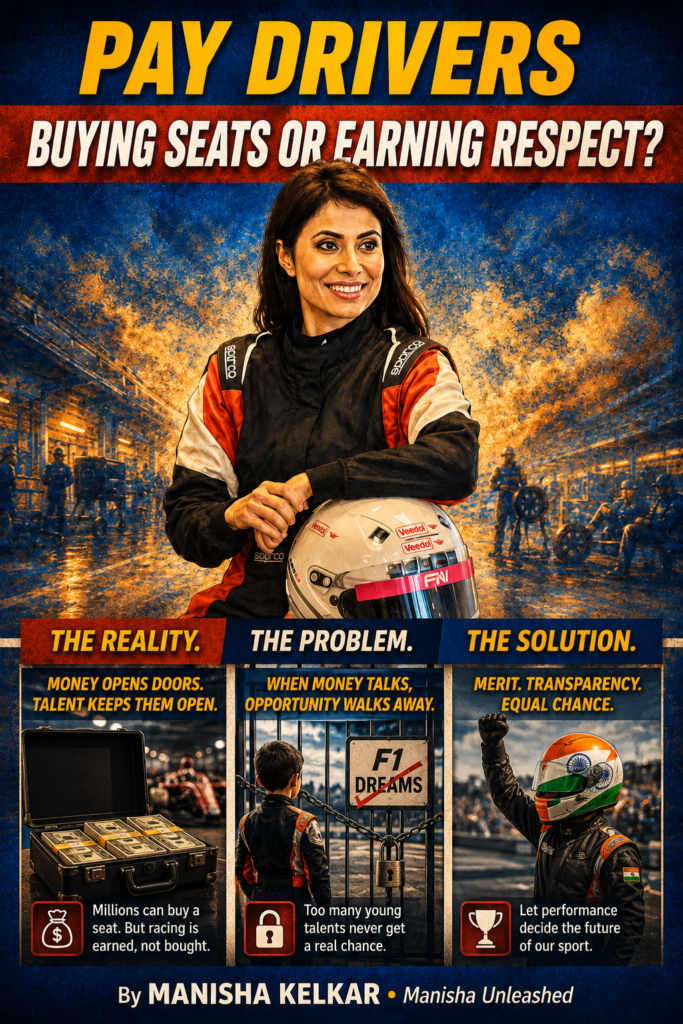
Manisha Unleashed: Are Pay Drivers Really Bad for Motorsport?
Unleashed Truth #2
There are few labels in motorsport more damaging than two simple words:
Pay driver.
The implication is obvious.
They’re only racing because they brought money.
They’ve bought the seat.
Someone more talented should be driving the car.
And sometimes, perhaps, there is some truth in that criticism.
But I think motorsport has created a strange double standard.
A driver who arrives with personal or family money is called a pay driver.
A driver who arrives with several million pounds of corporate sponsorship is called well backed.
A driver supported by a manufacturer is called a factory prospect.
A driver whose career is funded by a Formula One academy is called a junior driver.
But in every case, somebody is paying.
So where exactly does sponsorship end and being a pay driver begin?
And more importantly:
Are pay drivers really bad for motorsport?
Welcome back to Unleashed Truth, where I’m asking the questions motorsport doesn’t always want to answer.
Let’s Start With the Reality: Racing Costs Money
There is a romantic idea about motorsport that says:
If you’re fast enough, you’ll make it.
I wish it were that simple.
Talent matters enormously, but talent doesn’t pay for tyres.
It doesn’t pay mechanics.
It doesn’t transport a race car across Europe.
It doesn’t pay circuit fees, engineers, engines, testing, accident damage or championship entries.
Somebody has to pay those bills.
And long before a driver reaches Formula One, finding that money can become almost as important to their career as finding lap time.
That doesn’t necessarily make them a pay driver.
It makes them a racing driver trying to build a career.
Almost Everyone Needs Funding Somewhere
Think about the traditional path through motorsport.
Karting.
Formula 4.
Formula Regional.
Formula 3.
Formula 2.
Formula One.
At virtually every stage, there are substantial costs.
Very few young drivers can personally finance that entire journey.
So where does the money come from?
Parents.
Family businesses.
Personal wealth.
Sponsors.
Driver academies.
Manufacturers.
Investors.
National programmes.
Commercial partners.
At some point, most drivers need someone else to believe they’re worth supporting.
So perhaps the phrase pay driver is being used far too casually.
What’s the Difference Between £1 Million From Dad and £1 Million From a Sponsor?
This is where the argument becomes interesting.
Imagine two drivers.
Driver A arrives with £1 million provided by their family.
Driver B arrives with £1 million from corporate sponsors.
Both teams receive £1 million.
Yet motorsport culture may treat those drivers very differently.
Driver A gets labelled a pay driver.
Driver B gets praised for being commercially successful.
Why?
You could argue that Driver B had to persuade companies to invest and therefore demonstrated commercial ability.
That’s a legitimate distinction.
But from the team’s perspective, both drivers brought funding.
So perhaps the real question shouldn’t be:
“Did the driver bring money?”
It should be:
“Is the driver good enough to deserve the seat?”
That’s a much more useful conversation.
Being Sponsored Doesn’t Make You Slow
This seems obvious, but it’s worth saying.
A driver can bring money and still be extremely talented.
The two things aren’t mutually exclusive.
If a company believes in a young driver’s potential and pays for their Formula 3 season, that doesn’t suddenly make the driver less skilled.
If a manufacturer funds a promising driver’s development, we celebrate it.
If a Formula One team pays for its junior driver’s racing, we see that as an investment in talent.
So why should attracting independent commercial sponsorship automatically make someone less deserving?
In fact, finding sponsorship can require an entirely different set of skills.
You need to communicate.
Build relationships.
Represent brands.
Create exposure.
Understand marketing.
Develop an audience.
Deliver value.
Those abilities are increasingly part of being a professional racing driver.
But There Is a Problem
I’m not going to pretend the pay-driver criticism is completely unfair.
There is a point where money can distort sporting competition.
Imagine two drivers competing for one seat.
Driver A is clearly faster.
Driver B is clearly slower.
But Driver B brings a huge financial package.
Driver B gets the seat.
That’s uncomfortable.
Because now money hasn’t simply enabled someone to race.
Money has potentially displaced greater sporting ability.
And that’s where I believe the distinction matters.
Bringing sponsorship isn’t the problem.
Using money to compensate for a lack of required performance is.
What Is a Genuine Pay Driver?
My definition would be quite simple.
A pay driver isn’t merely someone who brings funding.
A genuine pay driver is someone whose financial contribution is substantially more important to securing or retaining the seat than their sporting performance.
That’s different.
If you’re competitive, meet the required standards and bring sponsors, you’re a racing driver with commercial backing.
If your performance consistently demonstrates that you shouldn’t be competing at that level but your money keeps you there, then I think the criticism becomes more legitimate.
The distinction should be based on competence, not simply where the cheque came from.
Teams Have to Survive Too
There’s another side of this discussion that fans sometimes overlook.
Race teams are businesses.
Engineers need salaries.
Mechanics need salaries.
Cars need maintaining.
Transporters need fuel.
Workshops cost money.
Tyres cost money.
Engines cost money.
Testing costs money.
Running a professional racing team is incredibly expensive.
A team cannot survive on sporting purity alone.
Sometimes accepting a funded driver allows a team to keep racing.
Perhaps that funding allows them to employ more people.
Develop the car.
Compete in another season.
Or even run a second driver who doesn’t have the same financial backing.
Would motorsport really be better if that team disappeared completely?
Probably not.
That’s why this issue isn’t as simple as saying:
“Pay drivers are bad.”
The Real Problem Starts Much Earlier
When people talk about pay drivers, they often focus on Formula One.
I think that’s looking at the end of the problem rather than the beginning.
By the time somebody reaches Formula One, thousands of aspiring drivers have already disappeared from the pathway.
Some weren’t good enough.
Some changed direction.
Some were injured.
Some lost motivation.
But others simply ran out of money.
That’s the part that concerns me.
For every highly visible driver accused of buying a seat, how many potentially brilliant drivers never got anywhere near that seat because they couldn’t finance Formula 4?
Or karting?
Perhaps the bigger problem isn’t that wealthy drivers can buy opportunities.
It’s that less wealthy drivers often can’t access enough opportunities to prove they deserve them.
Sponsorship Shouldn’t Be a Dirty Word
I think young drivers need to understand this clearly.
There is nothing embarrassing about needing sponsorship.
Motorsport is expensive.
If you can persuade companies to support your career because they believe in your ability, personality, audience or story, you should be proud of that.
But sponsorship comes with responsibility.
A sponsor isn’t simply there to pay your invoices.
You need to create value for them.
Promote them professionally.
Engage with their customers.
Create content.
Attend events.
Represent their brand properly.
Help them tell stories.
Build relationships.
And demonstrate why continuing to support you makes commercial sense.
The best sponsorship relationships aren’t charity.
They’re partnerships.
Drivers Are Becoming Brands
This is another reality of modern motorsport.
A racing driver isn’t only an athlete anymore.
They’re also a media personality, content creator and brand ambassador.
Social media has changed the equation dramatically.
A young driver with an engaged following may potentially offer a company significant exposure before reaching the highest levels of the sport.
Some traditionalists don’t like this.
They’ll say:
“Drivers should concentrate on driving.”
Of course they should.
Performance must remain fundamental.
But if two equally talented drivers are available and one can also attract fans, communicate brilliantly and generate commercial value, why wouldn’t a team consider that?
Professional motorsport has always existed at the intersection of sport and business.
Pretending otherwise doesn’t help young drivers understand the industry they’re entering.
Could Commercial Ability Actually Be Part of Driver Talent?
This might be controversial.
Perhaps we need to broaden our definition of what makes a successful professional racing driver.
Obviously, speed comes first.
But a long career also requires adaptability, communication, technical understanding, fitness, resilience and professionalism.
Why shouldn’t commercial intelligence be included?
If a driver can walk into a boardroom, explain their programme, persuade a company to invest and then deliver measurable value to that company, that’s a skill.
It shouldn’t replace driving ability.
But it shouldn’t be dismissed either.
Where I Draw the Line
For me, there are three very different situations.
Situation One:
A talented driver attracts sponsorship that allows them to race.
No problem.
Situation Two:
A talented driver comes from a wealthy family that finances their career.
Again, I don’t automatically have a problem with that. You don’t choose the family you’re born into, and having money doesn’t make you untalented.
Situation Three:
A driver repeatedly performs below the standard required for a championship but retains opportunities primarily because they provide significantly more money than stronger alternatives.
That’s where I become uncomfortable.
Because at that point, the financial system is beginning to override sporting merit.
Should Teams Ignore Money Completely?
It sounds wonderful.
Choose the fastest drivers.
Nothing else matters.
Unfortunately, I don’t think it’s realistic.
Motorsport doesn’t operate in an economic vacuum.
What I would prefer is a system where minimum performance standards protect the sporting integrity of championships, while teams and drivers remain free to build commercial partnerships.
If you meet the sporting standard, how your programme is funded becomes much less important to me.
Family money?
Sponsors?
Manufacturer?
Academy?
Investors?
Fine.
You’re good enough to be there.
Now race.
What Young Drivers Should Learn From This
If you’re trying to build a career in motorsport, don’t wait until you desperately need money before learning about sponsorship.
Start early.
Learn how businesses work.
Understand marketing.
Build your personal brand.
Create professional social media channels.
Learn to speak confidently.
Develop a sponsorship presentation.
Understand what exposure you can offer.
Build relationships before you need something.
And don’t approach companies with:
“I need £100,000 to race.”
That’s your problem.
The company wants to know:
“What can you do for us?”
Answer that question well and the entire conversation changes.
The Uncomfortable Truth
Here’s my Unleashed Truth.
Motorsport doesn’t have a pay-driver problem. It has an opportunity problem.
Money has always been part of racing.
The real concern isn’t that some drivers arrive with financial backing.
It’s that talented drivers without financial backing can disappear before they get enough opportunity to demonstrate what they’re capable of.
Calling every sponsored or wealthy driver a pay driver doesn’t solve that.
Creating more scholarships, manufacturer programmes, talent competitions and funded development pathways might.
Because the objective shouldn’t be to stop people with money from racing.
It should be to prevent people without money from being automatically excluded.
That’s a very different challenge.
What Would I Change?
I’d like to see more funded seats awarded through performance.
Not one-off prizes that provide a single test.
Real opportunities.
A complete karting season.
A Formula 4 championship.
Professional coaching.
Simulator time.
Fitness support.
Engineering education.
Media training.
Then evaluate the driver properly.
If they’re fast enough, help them progress again.
If they’re not, give the opportunity to someone else.
Manufacturers, major sponsors, national motorsport organisations and racing teams could all participate.
Instead of asking young drivers to find huge amounts of money before they’ve had the opportunity to prove themselves, give more of them the chance to earn their next step through performance.
So, Are Pay Drivers Really Bad for Motorsport?
My answer?
Not automatically.
A driver bringing money doesn’t mean they lack talent.
A driver having wealthy parents doesn’t mean they lack talent.
A driver attracting major sponsorship certainly doesn’t mean they lack talent.
Judge them on what happens when the visor comes down.
Are they fast enough?
Are they safe?
Are they competitive?
Do they improve?
Do they deserve to be racing at that level?
If the answer is yes, I’m far less interested in where their budget came from.
But if money repeatedly allows someone to occupy a seat despite clearly lacking the required performance, then motorsport has to ask whether commercial interests have started damaging sporting credibility.
That’s where I draw the line.
Now It’s Your Turn
So here’s this week’s Unleashed Truth question:
Where does sponsorship end and being a “pay driver” begin?
Should drivers who bring large budgets be criticised?
Should teams always choose the fastest available driver regardless of money?
Or is attracting funding simply another skill required to survive in professional motorsport?
And here’s the question I’m particularly interested in:
If two drivers are equally fast, but one brings £1 million in sponsorship, who would you put in the car?
Tell me what you think.
Because in motorsport, the stopwatch might decide who’s fastest…
but unfortunately, it doesn’t pay the bills.
— Manisha Kelkar
Manisha Unleashed | Motorsport Mania
UNLEASHED TRUTH
Asking the questions motorsport doesn’t always want to answer.