
Manisha Unleashed
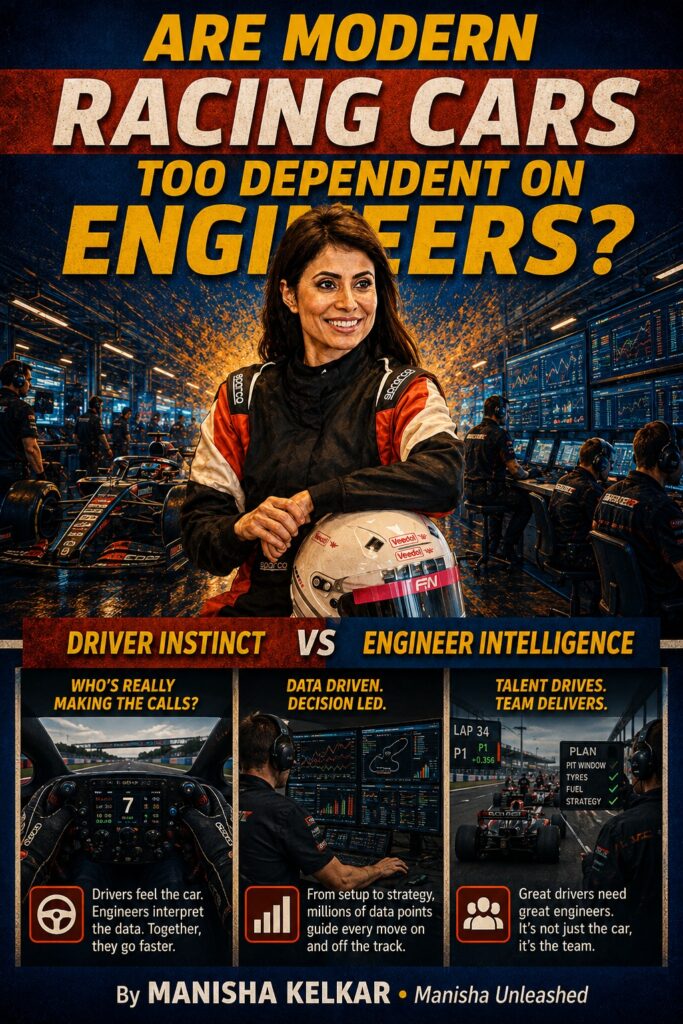
Are Modern Racing Cars Too Dependent on Engineers?
How much performance comes from the driver — and how much comes from data, simulation and engineering?
There is an image of the racing driver that motorsport loves.
One driver.
One machine.
One racetrack.
And a stopwatch.
The fastest driver wins.
Simple.
Except modern motorsport isn’t really like that.
Behind almost every professional racing driver is an increasingly sophisticated network of race engineers, performance engineers, data analysts, aerodynamicists, tyre specialists, strategists and simulator engineers.
Before the car even reaches the circuit, thousands of hours may already have been spent modelling its behaviour.
Then the driver goes out for a session.
Within minutes, engineers can potentially examine braking pressure, steering angle, throttle position, gear selection, speed, tyre behaviour and countless other parameters.
The driver says:
“I’m losing the rear through Turn 6.”
The engineer looks at the data.
And sometimes replies:
“Actually…”
That’s when the conversation gets interesting.
So here’s this week’s Unleashed Truth:
Are modern racing cars becoming too dependent on engineers?
And if technology can tell us almost everything a driver is doing, how much performance still comes from the person behind the wheel?
Racing Has Never Really Been Just About the Driver
Before criticising modern motorsport, we should remember something.
Engineers have always mattered.
Someone designed the engine.
Someone built the chassis.
Someone selected the gearing.
Someone prepared the suspension.
Someone decided tyre pressures.
Someone repaired the car.
Even in the earliest days of racing, drivers depended on mechanics and engineers.
The difference today is the amount of information available.
A driver from decades ago might return to the pits and say:
“The car is oversteering through the fast corners.”
The team would inspect the car, listen to the driver and make an educated change.
Today, that same conversation might involve telemetry, tyre data, GPS traces, onboard video and simulation.
The problem hasn’t changed.
How do we make the car faster?
The tools have.
The Stopwatch Doesn’t Tell You Why
Imagine I’m half a second slower than my teammate.
The timing screen tells me that.
But it doesn’t tell me why.
That’s where data becomes incredibly powerful.
Perhaps I’m braking five metres earlier.
Perhaps I’m carrying more speed into the corner but compromising my exit.
Perhaps my teammate releases the brake differently.
Maybe they’re getting onto the throttle earlier.
Or perhaps our driving is almost identical and the difference is coming from something else.
Without data, we might spend an entire session guessing.
With data, the answer can sometimes become obvious very quickly.
That’s not destroying driving skill.
It’s accelerating the learning process.
The Racing Driver Has Become Part Athlete, Part Engineer
Modern drivers need to understand much more than simply how to drive quickly.
A professional driver needs to communicate what the car is doing.
Understeer where?
Corner entry?
Mid-corner?
Exit?
High speed?
Low speed?
On power?
Off power?
Under braking?
Is it getting worse as the tyres age?
What happens when the fuel load changes?
The better you can describe the problem, the more effectively your engineers can work with you.
That’s why I don’t see engineers as people who take control away from drivers.
A great driver-engineer relationship can actually allow the driver to extract more of their ability.
But Has Data Made Drivers Lazy?
This is where I think there is a legitimate question.
Imagine a young driver completes five laps.
They return to the garage and immediately ask:
“What does the data say?”
I’d be tempted to answer:
“First, tell me what YOU think.”
That’s important.
A racing driver needs to develop feel.
What did the front tyres do?
Where did the rear move?
Where did you struggle?
Which corner felt good?
Where do you think you’re losing time?
Make the driver think first.
Then open the laptop.
Because if drivers become completely dependent on telemetry to explain their own performance, something valuable has been lost.
Data should confirm and challenge your understanding — not replace it.
What Happens When the Data Disagrees With the Driver?
This can be one of the most valuable moments in a debrief.
Driver:
“I think I’m losing time because I can’t carry enough speed into Turn 4.”
Engineer:
“You’re actually faster than your teammate on entry. You’re losing three-tenths on the exit.”
Now we have learned something.
Perhaps the driver’s perception was wrong.
Maybe carrying all that entry speed is precisely what caused the poor exit.
Without data, the driver might ask for a setup change.
The team changes the car.
The problem gets worse.
Data can prevent that.
And sometimes the most important engineering adjustment is:
Don’t adjust the car. Adjust the driver.
The Engineer Cannot Drive the Car
This is where I think critics sometimes go too far.
An engineer can tell me where I’m losing time.
They can suggest a different braking technique.
They can change the setup.
They can show me what my teammate is doing.
They can run simulations.
But eventually I have to leave the garage.
And when I arrive at the corner at racing speed, I have to do it.
The engineer can’t apply the brake for me.
They can’t feel the grip through my body.
They can’t correct the oversteer.
They can’t position the car within centimetres of the apex.
And they can’t make the split-second decisions required when another racing car is alongside me.
Information and execution are different things.
Knowing what to do doesn’t automatically mean you can do it.
Simulation Has Changed Everything
Simulation may be the biggest revolution.
Before a race weekend, teams can potentially model enormous numbers of scenarios.
Setup changes.
Aerodynamic configurations.
Gear ratios.
Energy use.
Tyre behaviour.
Fuel consumption.
Strategy.
Drivers can also learn circuits before arriving.
That creates an obvious question:
Are engineers now solving the race before the car even leaves the garage?
Not quite.
Simulation is incredibly powerful, but it is still a model of reality.
Then reality arrives.
The track temperature is different.
There’s more wind than expected.
The circuit has less grip.
It rains.
Another car damages yours.
Tyres behave differently.
A safety car changes the strategy.
Suddenly all the modelling in the world needs to adapt.
That’s where human judgement returns.
Engineers Don’t Eliminate Uncertainty
This is something I love about motorsport.
You can prepare endlessly.
You can simulate.
Analyse.
Model.
Predict.
Then somebody crashes three laps into the race and changes everything.
Now what?
That’s why great race engineers aren’t simply brilliant mathematicians.
They’re decision-makers.
They have to interpret incomplete information under pressure.
Drivers do exactly the same thing.
The best motorsport teams combine both.
Human instinct and engineering intelligence.
What About Setup?
This is another area where the relationship becomes fascinating.
People sometimes imagine there is one perfect setup for a racing car.
There isn’t.
Different drivers can want different things.
One driver might prefer a very responsive front end and tolerate movement from the rear.
Another might need greater rear stability to have confidence attacking corner entry.
Neither is necessarily wrong.
The objective isn’t to create the theoretically perfect racing car.
It’s to create the fastest combination of:
Car + Driver.
That final part matters.
An engineer can produce a setup that looks perfect in simulation.
If the driver has no confidence in it, it might be slower.
Confidence produces performance.
Engineering has to recognise that.
The Best Drivers Make Engineers Better
This is something that doesn’t get discussed enough.
The relationship works both ways.
Great engineers help drivers become faster.
But great drivers also help engineers understand cars.
A driver who can accurately explain what the car is doing provides incredibly valuable information.
They can identify subtle changes.
They can compare setups.
They can tell engineers whether a modification genuinely improves confidence and performance.
This is why technical feedback has always been highly valued in racing.
The fastest driver isn’t necessarily the driver who can communicate best.
But combine speed with excellent technical feedback and you have something extremely valuable.
Has Engineering Reduced the Importance of Natural Talent?
I don’t think so.
If anything, engineering can expose weaknesses more clearly.
Years ago, a driver might have been able to explain away a poor session:
“The car wasn’t right.”
Today, the engineer may have the data from the car directly alongside their teammate’s.
Same machinery.
Same conditions.
Different braking trace.
Different throttle application.
Different lap time.
The laptop can be brutally honest.
Technology doesn’t necessarily protect drivers.
Sometimes it removes their excuses.
What About Formula One?
Formula One represents the extreme.
Huge engineering resources.
Sophisticated simulation.
Massive quantities of data.
Strategy departments.
Advanced aerodynamic development.
Drivers receive constant information throughout a Grand Prix.
So does the driver still matter?
Absolutely.
Put a slower driver in the fastest car and the car doesn’t magically produce its theoretical lap time.
Someone still has to extract it.
And when two teammates have access to similar machinery and engineering resources, differences still appear.
That tells us something important.
Engineering can create potential.
The driver still has to convert potential into performance.
Endurance Racing Makes the Relationship Even More Interesting
This is particularly relevant to my own Road to Le Mans.
In endurance racing, several drivers share the same car.
That creates an enormous engineering challenge.
One driver might prefer one balance.
Another wants something different.
But there is only one car.
So everyone has to compromise.
Then there are fuel strategies.
Tyres.
Traffic.
Weather.
Driver changes.
Night running.
Energy management.
Reliability.
An endurance driver therefore needs to understand that sometimes the fastest theoretical setup for them personally isn’t the best setup for the team.
That requires maturity.
And it makes communication with engineers incredibly important.
Could a Driver Win Without Engineers?
At a serious professional level today?
Almost certainly not.
But turn the question around.
Could the engineers win without the driver?
No.
They can create the fastest car imaginable.
They can calculate the perfect setup.
They can model the ideal strategy.
They can determine exactly where the theoretical braking point should be.
Then someone has to climb into the car and make all of it happen while racing against other human beings doing exactly the same thing.
Motorsport isn’t driver versus engineer.
It’s driver plus engineer versus everyone else.
Are Young Drivers Becoming Too Dependent on Data?
This is where I would be cautious.
I love data.
But young drivers should learn to drive before they learn to obey a laptop.
Give them laps without immediately showing them telemetry.
Ask them to identify where they’re struggling.
Ask them what the car is doing.
Ask them what change they would make.
Then show them the data.
Were they right?
If yes, excellent.
If not, why did their perception differ from reality?
That’s how data becomes an educational tool rather than a crutch.
The goal should be to create a driver who can feel the problem and understand the numbers.
My Ideal Racing Driver
If I were developing a young driver, I wouldn’t choose between instinct and engineering.
I’d teach both.
Learn to feel grip.
Learn to control a slide.
Learn racecraft.
Learn to adapt.
But also:
Understand telemetry.
Learn basic vehicle dynamics.
Understand tyres.
Study braking traces.
Understand weight transfer.
Learn how setup changes affect the car.
Know enough engineering to have intelligent conversations with the people working on your car.
Because the modern racing driver shouldn’t be frightened of technology.
They should know how to use it.
Could Technology Eventually Go Too Far?
This is where my answer becomes less certain.
There has to be a point where engineering assistance could begin reducing the driver’s responsibility.
If technology eventually tells a driver precisely where to brake, exactly what line to take, exactly when to accelerate and continuously corrects their decisions, then yes, I think something important would disappear.
Racing should remain a test of human performance.
Technology should help us understand performance.
It shouldn’t perform the driving for us.
That distinction will become increasingly important as artificial intelligence, simulation and vehicle-control technology develop.
The Uncomfortable Truth
Here’s my Unleashed Truth:
Modern racing cars aren’t too dependent on engineers. Modern racing drivers are increasingly dependent on understanding engineering.
That’s different.
The driver who refuses to use data because they believe pure instinct is somehow more authentic is voluntarily giving away information.
But the driver who cannot understand the car without data has another problem.
The best drivers need both.
Feel and facts.
Instinct and analysis.
Driver and engineer.
That’s modern motorsport.
Who Really Deserves the Credit?
When a driver wins, they’re the person standing on the podium.
Their photograph appears everywhere.
But behind that result may be hundreds of people.
Engineers.
Mechanics.
Strategists.
Designers.
Data analysts.
Tyre engineers.
Simulator teams.
And many others the public never sees.
That doesn’t diminish the driver’s achievement.
It reminds us that motorsport is unusual.
It is simultaneously an individual sport and a team sport.
The driver is the final link in an enormous chain.
But it’s a very important link.
Because when the lights go out, the engineers don’t get to drive.
So, Are Modern Racing Cars Too Dependent on Engineers?
My answer is:
No — provided engineering helps the driver rather than replaces the driver.
Data makes us smarter.
Simulation makes preparation more effective.
Engineering makes cars faster.
Telemetry makes weaknesses easier to identify.
But the fundamental challenge remains.
Someone still has to take that information onto the racetrack and execute it at the limit.
And that’s where racing drivers earn their place.
Now It’s Your Turn
So here’s this week’s Unleashed Truth question:
How much of modern motorsport performance belongs to the driver — and how much belongs to the engineers?
If the world’s greatest driver is given an average car, can they still win?
If an average driver is given the greatest car, can engineering make them a champion?
And here’s an experiment I’d love to see:
Take the world’s best drivers, put them in identical cars, remove live telemetry and dramatically limit engineering support.
Who adapts fastest?
Who understands the car?
Who finds the setup?
And ultimately…
Who is genuinely fastest when the driver has to work out more of the answers?
Perhaps we’d discover something surprising.
Or perhaps we’d simply rediscover something racing has always known:
The engineer makes the car faster.
The driver makes it race.
— Manisha Kelkar
Manisha Unleashed | Motorsport Mania
UNLEASHED TRUTH
Asking the questions motorsport doesn’t always want to answer.